Evaluating Crowd Flow Forecasting Algorithms for Indoor Pedestrian Spaces: A Benchmark Using a Synthetic Dataset
Authors: Weiming Mai, Dorine Duives, Panchamy Krishnakumari, Serge Hoogendoorn
Abstract
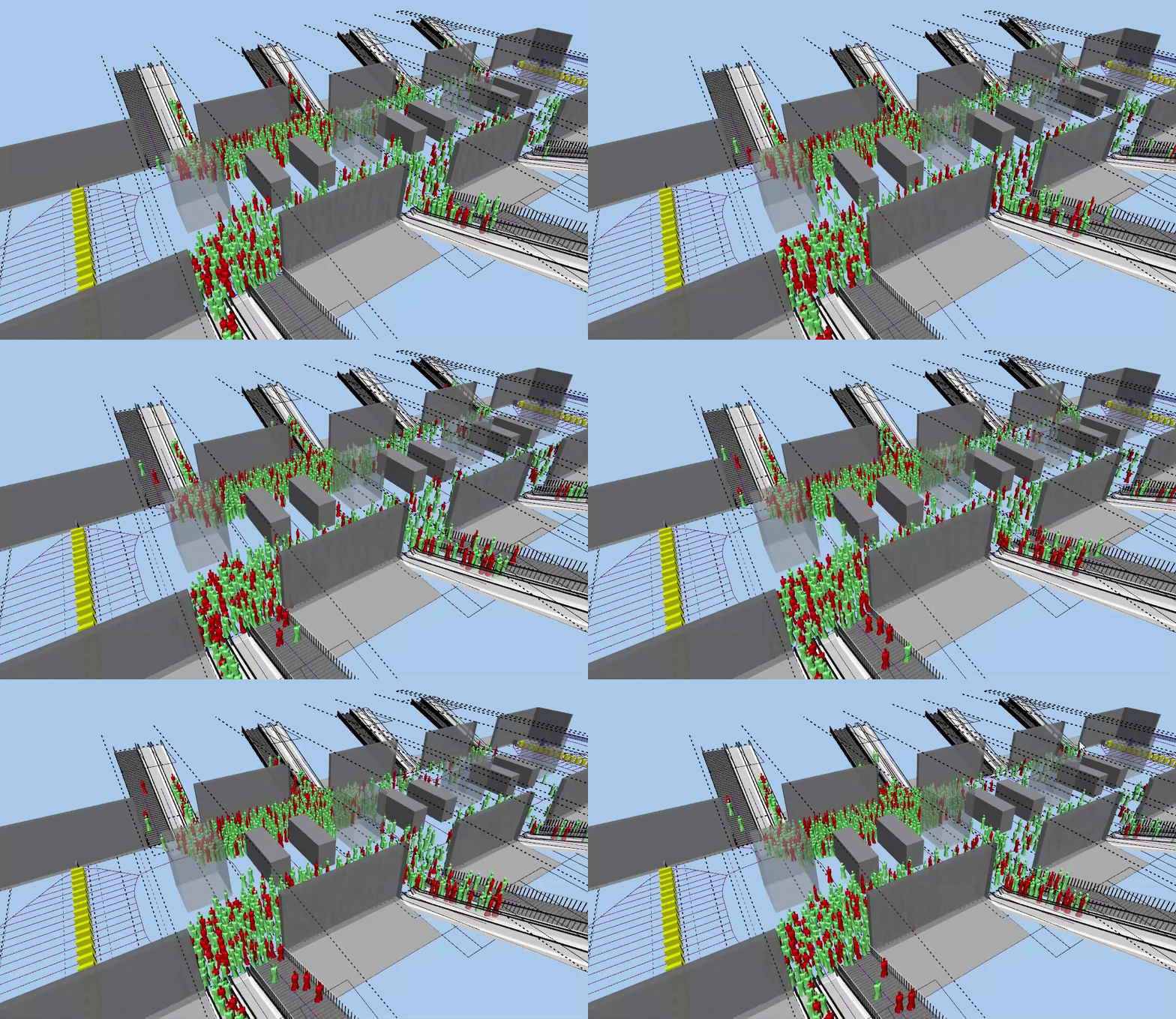
Accurate crowd flow forecasting in indoor pedestrian spaces (e.g., train stations, airports) is crucial for real-time crowd management and safety. However, evaluating and comparing different forecasting algorithms remains challenging due to the lack of standardized benchmarks and publicly available datasets with controlled conditions. In this paper, we address this gap by creating a comprehensive synthetic dataset simulating pedestrian flows in a train station environment under multiple scenarios with varying demand levels, network layouts, and flow patterns. We then benchmark a wide range of forecasting methods — including statistical approaches, deep learning models, and graph neural networks — on this dataset using consistent evaluation protocols. Our results reveal the strengths and weaknesses of each method under different operational conditions, providing practical guidance for selecting appropriate forecasting algorithms for indoor pedestrian spaces.
Key Contributions
- 1 A comprehensive synthetic benchmark dataset for indoor pedestrian crowd flow prediction with controllable scenarios.
- 2 Systematic evaluation of multiple forecasting methods (statistical, deep learning, GNN-based) under a unified protocol.
- 3 Practical insights and guidelines for algorithm selection based on operational conditions and space characteristics.
Results Overview
Benchmark Setup
The benchmark includes multiple train station layout scenarios with varying OD demand levels, enabling controlled comparison across different crowd density conditions.
Models Evaluated
Methods range from traditional statistical models (HA, ARIMA) to deep learning (LSTM, GRU) and graph-based approaches (STGCN, DCRNN, AGCRN), revealing trade-offs between complexity and performance.
Citation
@article{mai2025evaluating,
  title={Evaluating Crowd Flow Forecasting Algorithms for Indoor
         Pedestrian Spaces: A Benchmark Using a Synthetic Dataset},
  author={Mai, Weiming and Duives, Dorine and Krishnakumari,
          Panchamy and Hoogendoorn, Serge},
  journal={IEEE Transactions on Intelligent Transportation Systems},
  year={2025},
  publisher={IEEE}
}